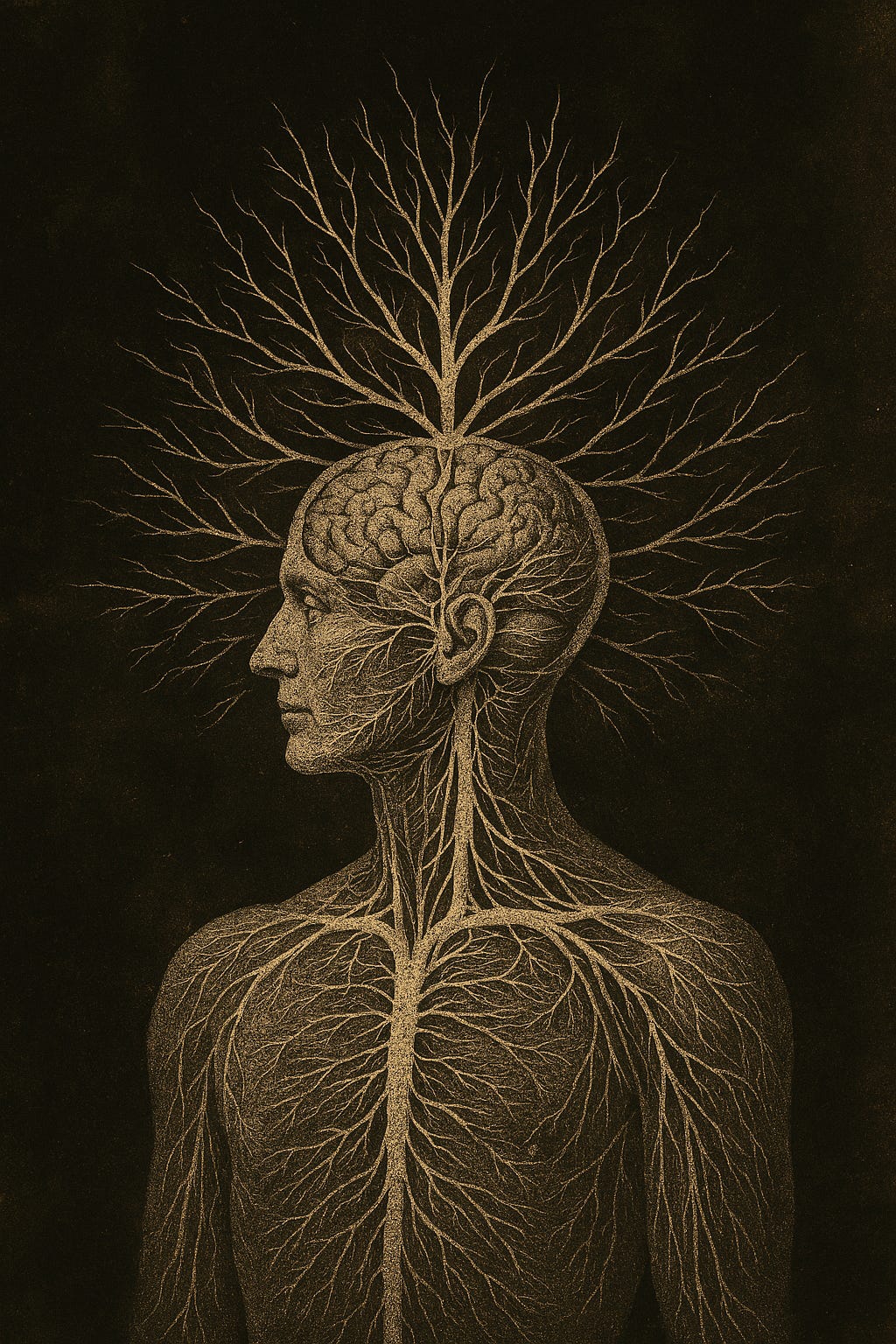
The Culture Of Anaesthesia
 Rachel Taylor
The Culture of Anaesthesia
We need to name what has happened.
Not gently.
Not metaphorically.
Not in the language of wellness.
But in the language of circuitry, thresholds, and biological truth.
Because an entire culture has been anaesthetised — softened, soothed, and weakened — by practices that were sold as healing but functioned as sedation.
This is the architecture of that anaesthesia.
1. Soothing Replaced Structure
We were told to breathe, ground, soften, and ‘regulate’ — as if the nervous system were a mood, not a system.
Breathwork and grounding influence state, not structure.
They can shift autonomic tone temporarily, but they do not alter:
- synaptic thresholds
- inhibitory circuitry
- cortical‑subcortical integration
- interoceptive accuracy
- dopaminergic baseline regulation
The nervous system is governed by electrical signalling, metabolic load, prediction models, and inhibitory control — not emotional ambience.
Breathing can modulate vagal tone for minutes.
It cannot rebuild circuitry.
Breathwork became a universal prescription.
Breathwork activates baroreceptors and modulates parasympathetic output, but:
- it does not change GABAergic inhibitory networks
- it does not recalibrate cortical thresholds
- it does not repair stress‑induced dendritic retraction
- it does not restore prefrontal‑amygdala connectivity
It shifts physiology transiently.
It does not create durable regulatory capacity.
Grounding became a ritual of avoidance.
Grounding reduces sensory load and can downshift arousal, but:
- it bypasses the insula, the region responsible for interoception
- it reduces exposure to the signals needed for prediction‑error updating
- it can reinforce avoidance pathways in the anterior cingulate cortex
- it prevents the nervous system from learning to tolerate complexity
Grounding soothes by reducing input.
Regulation strengthens by increasing capacity.
Softness became a performance of safety.
Safety is not a feeling.
It is a neurobiological condition involving:
- accurate interoceptive signalling (insula)
- stable inhibitory control (prefrontal cortex)
- low prediction error (anterior cingulate)
- balanced dopaminergic tone (ventral striatum)
Performing calmness does not activate these systems.
It often suppresses them.
None of it recalibrated thresholds
Thresholds refer to:
- neuronal firing thresholds
- stress‑response activation thresholds
- dopamine reward thresholds
- sensory tolerance thresholds
These recalibrate through repetition, load, and exposure, not soothing.
Breathwork lowers arousal.
It does not shift thresholds upward.
None of it restored inhibitory control.
Inhibitory control depends on:
- GABAergic interneurons
- prefrontal cortex integrity
- corticostriatal loops
- metabolic stability
Chronic stress weakens these systems.
Soothing does not rebuild them.
Only structured, repeated, load‑bearing regulation does.
None of it rebuilt the circuitry that makes presence possible.
Presence requires:
- strong insula–prefrontal connectivity
- stable default mode network down‑regulation
- efficient salience network switching
- balanced dopamine and noradrenaline tone
These are structural processes.
They require training, not calming.
It soothed. It did not strengthen.
Soothing reduces symptoms.
Strengthening increases capacity.
Soothing lowers arousal.
Strengthening raises thresholds.
Soothing creates relief.
Strengthening creates regulation.
Soothing is passive.
Strengthening is structural.
2. Sentiment Replaced Science
We were told to ‘listen to our bodies’ without being taught interoception.
Interoception is not intuition.
It is a neural process governed primarily by:
- the insula (interoceptive cortex)
- the anterior cingulate cortex
- vagal afferent pathways
- predictive coding loops that compare internal signals to expected states
Most people do not “listen to their bodies” — they listen to anxiety, habit, or prediction error.
Without training the insula to detect, interpret, and update internal signals, “listening to your body” becomes guesswork, not regulation.
Interoception is a skill.
Not a sentiment.
We were told to ‘feel our feelings’ without understanding cortical saturation.
Cortical saturation occurs when the prefrontal cortex is overwhelmed by:
- excessive emotional load
- chronic stress
- high prediction error
- insufficient inhibitory control
When the cortex is saturated:
- emotional processing becomes noisy
- executive function collapses
- the amygdala dominates
- feelings become signals of overload, not insight
“Feeling your feelings” without restoring cortical capacity often amplifies dysregulation.
It increases activation.
It does not increase regulation.
We were told to ‘be present’ without restoring the systems that detect presence.
Presence is not a mindset.
It is a network function involving:
- the salience network (insula + anterior cingulate)
- the default mode network (DMN)
- the central executive network (prefrontal cortex)
- the switching mechanism governed by the anterior insula
When these networks are dysregulated:
- the DMN dominates (rumination)
- the salience network misfires (hypervigilance)
- the executive network goes offline (inhibition failure)
You cannot “be present” when the networks that detect presence are offline.
Presence requires restored circuitry, not intention.
We were given slogans instead of structure.
Slogans activate semantic memory, not neural recalibration.
Structure — repetition, load, threshold work — activates:
- synaptic strengthening
- inhibitory interneuron recruitment
- dopaminergic baseline stabilisation
- prediction‑error updating
Slogans soothe.
Structure rewires.
Ambience instead of architecture.
Ambience changes state.
Architecture changes capacity.
Ambience affects:
- sensory load
- emotional tone
- short‑term autonomic shifts
Architecture affects:
- cortical thickness
- synaptic density
- inhibitory control
- interoceptive accuracy
- network integration
Ambience is temporary.
Architecture is functional.
3. Dopamine Replaced Discipline
Novelty was sold as healing.
Novelty triggers phasic dopamine spikes via the ventral tegmental area (VTA).
These spikes create:
- short‑term motivation
- a sense of possibility
- transient relief from dysphoria
But novelty does not:
- stabilise baseline dopamine
- strengthen prefrontal inhibitory circuits
- recalibrate reward thresholds
- build long‑term regulatory capacity
Novelty feels like movement.
It is not regulation.
Aesthetics were sold as transformation.
Aesthetic environments activate:
- the mesolimbic reward pathway
- the orbitofrontal cortex (valuation)
- the insula (sensory pleasure)
This creates a sense of uplift or “shift,” but:
- it does not change synaptic density
- it does not repair stress‑induced dendritic loss
- it does not restore executive function
- it does not recalibrate autonomic thresholds
Aesthetic stimulation is dopaminergic, not structural.
Stimulation was sold as vitality.
Stimulation increases:
- dopamine
- noradrenaline
- cortical activation
This produces a feeling of energy or aliveness, but it is borrowed energy, not biological capacity.
Vitality requires:
- metabolic stability
- inhibitory control
- efficient network switching
- balanced dopaminergic tone
Stimulation mimics vitality.
It does not create it.
But dopamine thresholds rose.
Repeated dopamine spikes — from novelty, stimulation, aesthetics, or soothing — cause:
- downregulation of D2 receptors
- increased reward thresholds
- reduced sensitivity to ordinary stimuli
This is the same mechanism seen in behavioural addiction, chronic overstimulation, and emotional dependency.
When thresholds rise, people need more to feel less.
Baselines collapsed.
Baseline dopamine (tonic dopamine) governs:
- motivation
- sustained attention
- capacity for ordinary life
- ability to tolerate low‑stimulation environments
Chronic phasic spikes deplete tonic dopamine, leading to:
- anhedonia
- low motivation
- emotional flatness
- difficulty initiating tasks
- reliance on external stimulation
This is the collapse of baseline capacity.
Ordinary life became insufficient.
When dopamine thresholds rise and baselines fall:
- everyday tasks feel empty
- rest feels agitating
- stillness feels intolerable
- presence feels impossible
This is not a personality issue.
It is a neurochemical shift caused by chronic overstimulation.
People mistook activation for aliveness.
Activation = dopamine + noradrenaline spikes.
Aliveness = balanced autonomic tone + stable cortical networks.
Activation is:
- fast
- shallow
- unsustainable
Aliveness is:
- slow
- structural
- metabolically grounded
People learned to chase activation because their baselines were collapsing.
And relief for restoration.
Relief reduces discomfort.
Restoration increases capacity.
Relief is:
- dopaminergic
- short‑term
- externally driven
Restoration is:
- structural
- threshold‑based
- internally stabilised
- dependent on inhibitory control and network integration
Relief soothes the system.
Restoration rebuilds it.
4. Neuroscience Was Diluted
Polyvagal theory was turned into a mood board.
Polyvagal theory describes brainstem‑mediated autonomic pathways, not emotional vibes.
The real mechanisms involve:
- ventral vagal complex (social engagement, inhibitory control)
- dorsal vagal complex (shutdown, metabolic conservation)
- sympathetic chain (mobilisation)
These are neurophysiological circuits, not feelings.
When polyvagal theory is reduced to “safe vs unsafe vibes,” people lose sight of:
- vagal afferent signalling
- brainstem integration
- metabolic load
- interoceptive accuracy
- inhibitory tone
The theory becomes aesthetic, not anatomical.
Trauma theory was reduced to emotional management.
Trauma is not an emotion.
It is a neurobiological shift involving:
- amygdala hyperactivation
- hippocampal volume reduction
- prefrontal cortex inhibition
- disrupted salience network switching
- altered prediction‑error processing
When trauma theory is reduced to “feel your feelings,” people are taught to manage symptoms rather than restore:
- cortical control
- network integration
- inhibitory pathways
- autonomic thresholds
Emotional management is not trauma resolution.
It is coping.
Neuroplasticity was invoked without repetition, thresholds, or discipline.
Neuroplasticity is not a mindset.
It is a metabolic and structural process requiring:
- repeated activation of specific circuits
- sufficient intensity to cross firing thresholds
- consistent reinforcement over time
- inhibitory pruning of unused pathways
- adequate sleep, glucose, and oxygen
Without repetition and threshold‑based load, neuroplasticity does not occur.
Invoking neuroplasticity without structure is like invoking muscle growth without resistance.
It sounds inspiring.
It does nothing.
The nervous system became a brand.
Branding activates reward pathways, not regulatory pathways.
When the nervous system becomes a brand:
- dopamine spikes replace inhibitory control
- aesthetics replace architecture
- identity replaces interoception
- performance replaces presence
People feel connected to the idea of regulation while their actual circuitry remains unchanged.
A marketing tool.
Marketing leverages:
- novelty
- emotional resonance
- aesthetic cues
- dopamine‑driven engagement loops
None of these strengthen:
- prefrontal cortex function
- autonomic stability
- interoceptive accuracy
- inhibitory control
Marketing creates activation.
Regulation requires structure.
A lifestyle aesthetic.
Aesthetic environments activate:
- the orbitofrontal cortex (valuation)
- the ventral striatum (reward)
- the insula (sensory pleasure)
This produces a sense of “shift,” but it is dopaminergic, not structural.
Aesthetic calm is not autonomic regulation.
It is sensory modulation.
And people became weaker for it.
When neuroscience is diluted:
- thresholds do not rise
- inhibitory control does not strengthen
- cortical networks do not integrate
- autonomic resilience does not increase
People become:
- more dependent on external soothing
- less tolerant of internal signals
- more reactive to stress
- less capable of sustained presence
This is not healing.
It is deconditioning.
5. Emotional Performance Replaced Capacity
Calmness was rewarded.
Calmness is a behavioural presentation, not a neurobiological state.
A person can appear calm while experiencing:
- high amygdala activation
- suppressed insula signalling
- elevated cortisol
- reduced prefrontal inhibitory control
This is called autonomic masking — the outward performance of calm while the internal system remains dysregulated.
Rewarding calmness reinforces suppression, not regulation.
Softness was praised.
Softness often reflects down‑regulated behaviour, not restored physiology.
Soft behaviour can coexist with:
- low vagal tone
- impaired interoception
- reduced cortical engagement
- passive coping strategies mediated by the dorsal vagal complex
Softness can be a shutdown response, not a sign of safety.
When softness is praised, people learn to appear regulated rather than be regulated.
Compliance was framed as healing.
Compliance activates social safety behaviours, not regulatory circuits.
Compliance is often driven by:
- prefrontal inhibition of authentic signals
- fear‑based suppression of the amygdala
- avoidance of conflict (anterior cingulate over‑activation)
- learned helplessness pathways in the ventral striatum
Compliance reduces friction.
It does not restore capacity.
Articulation was misread as confrontation.
Articulation requires:
- strong prefrontal cortex activation
- intact language networks
- high interoceptive clarity
- stable inhibitory control
When someone articulates clearly under stress, it is a sign of capacity, not aggression.
But dysregulated systems (in both patient and practitioner) often misinterpret:
- precision as threat
- clarity as challenge
- agency as defiance
This is a prediction‑error bias in the listener’s nervous system, not a flaw in the speaker.
Discernment was labelled difficult.
Discernment depends on:
- prefrontal–insula integration
- accurate salience network switching
- stable dopamine baselines
- low prediction error
When someone discerns, they are using high‑level cortical processing.
But systems conditioned to reward compliance interpret discernment as:
- resistance
- complexity
- non‑conformity
This is a misinterpretation of executive function as difficulty.
Sovereignty was pathologised.
Sovereignty requires:
- strong inhibitory control
- high interoceptive accuracy
- stable autonomic thresholds
- integrated prefrontal–limbic circuitry
A sovereign nervous system is:
- less dependent
- less compliant
- less easily soothed
- less easily controlled
Systems built on soothing and compliance often pathologise sovereignty because it disrupts the expected relational pattern.
This is not pathology.
It is capacity.
People learned to perform wellness instead of restoring the systems that make wellness possible.
Performance activates:
- mirror neuron systems
- social reward pathways
- short‑term dopaminergic reinforcement
But it does not restore:
- inhibitory GABAergic networks
- prefrontal regulation
- interoceptive accuracy
- autonomic resilience
- network integration (DMN, salience, executive)
Performance is external.
Capacity is internal.
Performance is behavioural.
Capacity is structural.
Performance soothes others.
Capacity stabilises the self.
6. Dependency Replaced Agency
External regulation became the norm.
External regulation relies on exogenous cues to stabilise the nervous system:
- another person’s voice, tone, or presence
- guided breathing
- co‑regulation practices
- therapist‑led emotional scaffolding
These activate social engagement pathways (ventral vagal complex) and can temporarily reduce arousal.
But external regulation does not strengthen:
- prefrontal inhibitory control
- insula‑mediated interoception
- autonomic thresholds
- corticostriatal loops that support self‑initiation
When external regulation becomes the default, internal regulatory circuits weaken through non‑use–dependent plasticity.
Practitioners became the regulators.
When practitioners act as the primary regulators, clients outsource:
- prediction‑error resolution
- emotional modulation
- decision‑making
- autonomic stabilisation
This creates dependency loops mediated by:
- dopaminergic reward (relief from distress)
- reduced prefrontal activation (outsourcing agency)
- increased amygdala sensitivity (reliance on external soothing)
The practitioner becomes the prefrontal cortex substitute, preventing the client’s own circuitry from strengthening.
Clients became the regulated.
When clients rely on external cues:
- the insula becomes less accurate
- the anterior cingulate becomes more avoidant
- the prefrontal cortex becomes less engaged
- the autonomic system becomes more fragile
This is the neurobiology of learned dysregulation.
People become regulated by others, not through themselves.
Healing became a subscription model.
Subscription‑based healing exploits:
- dopamine‑driven anticipation
- intermittent reinforcement
- novelty‑seeking behaviour
- emotional dependency loops
This keeps the nervous system in a cycle of:
- temporary relief
- rapid return to baseline dysregulation
- renewed seeking of external input
It is not healing.
It is dopaminergic maintenance.
Progress became a performance.
Performance activates:
- mirror neuron systems (social mimicry)
- orbitofrontal cortex (social valuation)
- ventral striatum (reward for approval)
But performance does not activate:
- inhibitory GABAergic networks
- interoceptive accuracy
- autonomic resilience
- prefrontal‑limbic integration
People learn to look regulated rather than be regulated.
Completion became impossible by design.
When healing is structured around:
- endless emotional processing
- perpetual soothing
- constant practitioner involvement
- novelty‑based interventions
…the nervous system never receives:
- repetition
- load
- threshold‑based exposure
- inhibitory strengthening
These are the conditions required for neuroplastic completion.
Without them, the system remains in perpetual dysregulation.
People were kept regulated enough to function but never restored enough to rise.
This is the hallmark of low‑capacity autonomic stability:
- enough ventral vagal activation to reduce symptoms
- insufficient prefrontal engagement to build capacity
- enough dopamine to feel progress
- insufficient inhibitory control to sustain it
- enough soothing to prevent collapse
- insufficient load to create resilience
People become functional but fragile.
Stable enough to comply.
Not strong enough to transform.
This is not restoration.
It is containment.
Radical Restoration Refuses All of This
Radical Restoration is not soothing.
Soothing activates short‑term parasympathetic shifts:
- mild vagal activation
- reduced sympathetic output
- transient decreases in heart rate and cortisol
These are state changes, not structural changes.
Soothing does not:
- strengthen inhibitory networks
- recalibrate stress thresholds
- rebuild cortical‑subcortical integration
Soothing reduces discomfort.
It does not increase capacity.
It is not ambience.
Ambience modulates sensory input, not neural architecture.
Soft lighting, calm voices, and aesthetic environments influence:
- the insula (sensory pleasure)
- the orbitofrontal cortex (valuation)
- dopaminergic reward pathways
Ambience creates a feeling of safety.
It does not create the capacity for safety.
It is not emotional softness.
Softness is a behavioural presentation, not a neurobiological state.
Soft behaviour can coexist with:
- high amygdala activation
- low vagal tone
- impaired interoception
- reduced prefrontal engagement
Softness can be a shutdown response, not regulation.
It is structural.
Structure refers to actual neural architecture, including:
- synaptic density
- dendritic branching
- inhibitory interneuron strength
- network integration (DMN, salience, executive)
These change only through repetition, load, and threshold‑based training.
Structure is the opposite of soothing.
It is exacting.
Exactness is the domain of:
- prediction‑error updating
- inhibitory control
- cortical precision
- autonomic calibration
These systems require precision, consistency, and metabolic investment.
They do not respond to ambience.
They respond to discipline.
It is biological.
Biology governs:
- firing thresholds
- neurotransmitter baselines
- autonomic tone
- metabolic capacity
- network switching
These are physiological realities, not emotional preferences.
Radical Restoration works with biology, not sentiment.
It returns you to the system — not the mood.
The system =
- the insula (interoception)
- the prefrontal cortex (inhibition)
- the amygdala (threat detection)
- the anterior cingulate (prediction error)
- the autonomic nervous system (arousal regulation)
Mood is a surface‑level output.
The system is the architecture underneath.
Restoration works at the level of circuitry, not feelings.
It recalibrates thresholds.
Thresholds include:
- neuronal firing thresholds
- stress‑response activation thresholds
- dopamine reward thresholds
- sensory tolerance thresholds
Threshold recalibration requires:
- repeated exposure
- controlled load
- inhibitory strengthening
This is the opposite of soothing.
It restores inhibitory control.
Inhibitory control depends on:
- GABAergic interneurons
- prefrontal cortex integrity
- corticostriatal loops
- balanced dopamine and noradrenaline
When inhibitory control is restored:
- reactivity decreases
- discernment increases
- emotional stability becomes possible
This is the foundation of sovereignty.
It rebuilds the architecture of presence, discernment, and human agency.
Presence requires:
- strong salience network switching
- down‑regulated default mode network
- accurate interoception
Discernment requires:
- prefrontal–insula integration
- stable dopamine baselines
- low prediction error
Agency requires:
- inhibitory control
- autonomic resilience
- cortical‑subcortical coherence
These are structural capacities, not emotional states.
This is the work.
Not the aesthetic. Not the performance. Not the soothing.
Aesthetic = sensory modulation
Performance = behavioural mimicry
Soothing = symptom reduction
None of these change:
- synaptic architecture
- inhibitory strength
- autonomic thresholds
- network integration
Radical Restoration does.
The restoration.
Restoration is:
- structural
- metabolic
- threshold‑based
- inhibitory
- cortical
- autonomic
- architectural
It is the rebuilding of the system that makes sovereignty possible.
Hard Biological Facts About Why You Need To Know All Of This -
1. A dysregulated nervous system increases the risk of chronic illness.
When autonomic thresholds collapse, the body shifts into chronic sympathetic activation or parasympathetic shutdown, which is linked to:
- impaired immune function
- increased inflammation
- disrupted gut motility
- hormonal imbalance
- cardiovascular strain
This is not psychological.
It is pathophysiology.
2. Low vagal tone is associated with higher mortality.
Low vagal tone — a marker of poor autonomic regulation — correlates with:
- higher risk of cardiac events
- poorer recovery from illness
- reduced resilience to stress
- increased allostatic load
This is measurable.
It predicts outcomes.
3. Chronic stress shrinks the prefrontal cortex.
Long‑term dysregulation causes:
- dendritic retraction in the prefrontal cortex
- reduced inhibitory control
- impaired decision‑making
- difficulty planning, initiating, and completing tasks
This is why people lose function, not motivation.
4. The amygdala enlarges under chronic threat.
An enlarged amygdala leads to:
- heightened reactivity
- exaggerated threat perception
- emotional volatility
- difficulty calming down
This is not personality.
It is structural change.
5. Cortisol dysregulation disrupts every major system.
Chronic cortisol elevation or depletion affects:
- sleep
- digestion
- metabolism
- immune function
- memory
- energy production
This is why people feel exhausted, foggy, and unwell.
6. Poor interoception leads to medical mismanagement.
When the insula cannot accurately read internal signals:
- pain is misinterpreted
- hunger and fullness cues disappear
- early signs of illness go unnoticed
- emotional states are confused with physical states
This leads to delayed diagnosis and worsening symptoms.
7. Low dopamine baselines cause functional collapse.
When dopamine thresholds rise and baselines fall, people experience:
- anhedonia
- low motivation
- inability to initiate tasks
- emotional flatness
- dependence on external stimulation
This is not laziness.
It is neurochemical depletion.
8. Autonomic dysfunction reduces life expectancy.
Conditions involving chronic dysregulation — including POTS, vagal dysfunction, and parasympathetic dominance — are associated with:
- reduced exercise tolerance
- impaired blood pressure regulation
- fainting, dizziness, and fatigue
- reduced ability to perform daily tasks
This directly reduces quality of life.
9. Cognitive impairment is a biological consequence of dysregulation.
When the nervous system is overloaded:
- working memory declines
- processing speed slows
- attention fragments
- executive function collapses
This is why people cannot “push through.”
10. A weakened nervous system reduces lifespan and life participation.
When thresholds collapse and inhibitory control fails, people experience:
- reduced mobility
- reduced independence
- reduced social engagement
- reduced capacity for work
- reduced ability to care for themselves
This is not emotional.
It is functional decline.
Why this matters
Because a weakened nervous system is not a mood problem.
It is not a mindset issue.
It is not a lack of effort.
It is a biological condition that:
- reduces lifespan
- reduces cognitive capacity
- reduces physical function
- reduces emotional stability
- reduces independence
- reduces quality of life
Understanding this is not optional.
It is the difference between soothing symptoms and restoring a life.
I have given my life to the nervous system — to its circuitry, its thresholds, its exquisite precision, its quiet signals, its catastrophic collapses, its astonishing capacity to rise again.
I love its nuances, its contradictions, its brutal honesty.
I love the way it tells the truth long before the mind is willing to hear it.
And I refuse to let a culture addicted to soothing reduce this system to a mood, a metaphor, or an aesthetic.
Radical Restoration is my line in the sand. It is the return to biology, to structure, to the architecture that makes presence, discernment, and human agency possible.
This work is not gentle. It is not soft. It is not ambient.
It is the disciplined reclamation of the system that governs every moment of our lives.
And if we do not restore it, we lose not only our health, but our clarity, our capacity, our sovereignty.
This is why it matters.
This is why I will not dilute.
This is why I will not stop.
Because the nervous system is not just my field of study — it is my devotion, my discipline, and the foundation of every human life that deserves to rise.